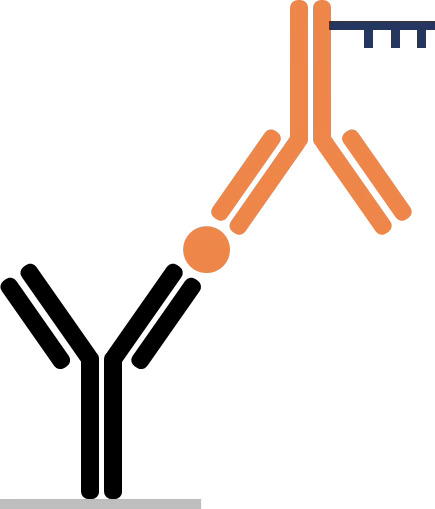
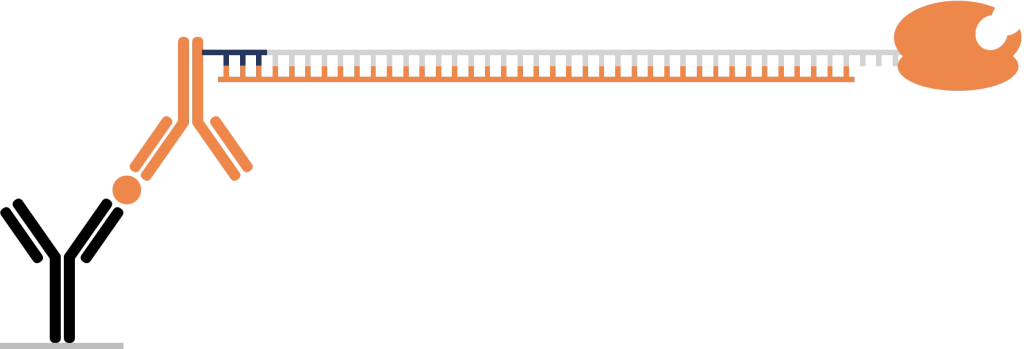
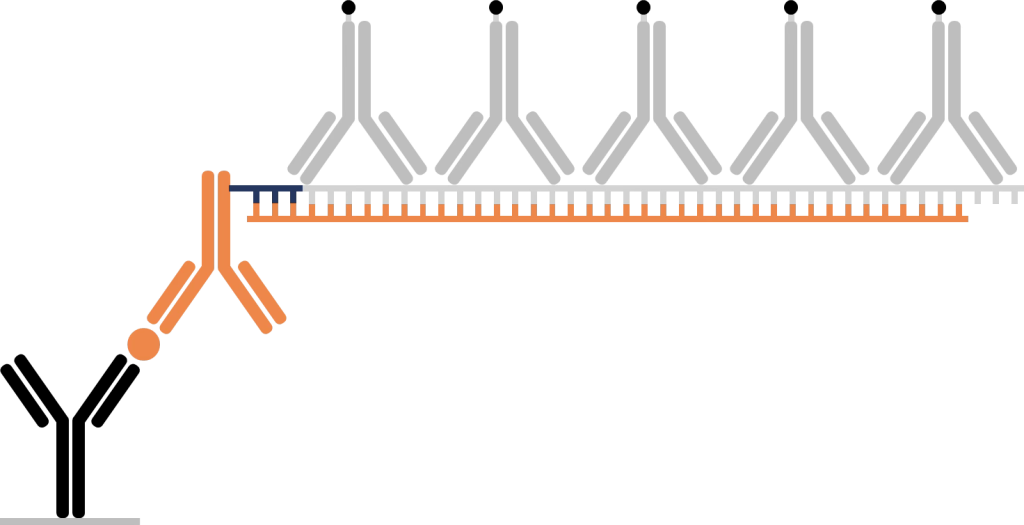
The procedure described below applies to Gyrolab assays based on the well-established sandwich principle, where biotinylated capture reagent is introduced into a microstructure in the microfluidic disc to saturate a capture column packed with streptavidin coated beads. Subsequently, samples are volume defined and introduced into the microstructures where the analyte of interest is captured in the affinity column. BOLD technology utilizes an oligo-labeled detection antibody rather than a directly labeled Alexa Fluor antibody. Through enzymatic amplification, BOLD generates a large number of binding sites on each detection event. These amplified sites can then be recognized when a detection reagent labeled with Allophycocyanin (APC) is added1, significantly enhancing detectable signal/response and assay sensitivity. The integrated fluorescent signal represents the response from the sample.
Recommended Bioaffy™ products:
We recommend the use of Gyrolab BioaffyTM 4000 discs (P0020705) and the Gyrolab Accessories Bundle (P0020863). The BOLD protocol is also suitable for use with Gyrolab Bioaffy 1000 (P0004253) or Gyrolab Bioaffy 200 (P0004180) discs depending on the analytical range of the analyte of interest. These products can be ordered separately from Gyros Protein Technologies.
Recommended Exazym® products:
An Exazym ClickChem Conjugation Kit (10-0001-01) is required to produce a 50 µg stock of detection antibody-oligo dT conjugate. In addition, an Exazym Polymerase Reaction Kit (10-1001-01) and Exazym APC Detection Kit (10-2002-01) are required for the assay. These reagent kits can be purchased from a Cavidi distributor, or at www.cavidi.se
Recommended Gyrolab methods:
Gyrolab methods have been developed to include the required instrument steps to utilize BOLD technology. All Gyrolab methods can be obtained from your local Field Application Specialist
Preparations
Equilibrate the Gyrolab Bioaffy disc (Gyrolab Bioaffy 4000 recommended) at room temperature for at least 30 minutes in the unopened aluminum pouch
Prepare PBS-T
Prepare Wash Station solution 2
Dissolve one package (10 g) of Gyrolab Wash Buffer pH 11 powder in 1 L of deionized or distilled water
Filter the solution through a 0.22 or 0.45 µm filter. Prepare fresh wash solution weekly.
Ensure that pipetting routines are designed to minimize contamination, e.g. use clean pipettes and new tips. Contamination may reduce the utility/shelf life of the reagent
Prepare a standard curve and/or samples
Allow the reagents to reach room temperature and vortex gently. Centrifuge the APC labeled detection reagent at 12 000 x g for 4 minutes to pellet any aggregates that may have formed during storage. Avoid pipetting from the bottom of the detect reagent tube to avoid transferring aggregates.
Place reagents, standards, controls, samples and wash buffers in a 96-well plate according to the loading list.
Capture antibody:
Preparation before use – Biotinylated capture antibody
The biotinylated antibody concentrations should be diluted in PBS-T and optimized for each application, but a good starting point is:
For a BOLD assay being adapted from an existing Gyrolab assay: start with the same capture concentration as the original assay.
For assay being developed directly using the BOLD technology: The antibody concentrations should be optimized for each application, but a recommended starting point is a final concentration of 100 µg/mL in PBS-T.
Standards and Samples:
Prepare standard curves and samples in an appropriate Rexxip buffer.
Certain sample matrices may interfere with the assay and to test this, we recommend diluting the samples in several different dilutions to assess the minimum required dilution.
Centrifuge serum samples at 3 000 x g for 12 minutes to sediment any aggregates or particulates that may be present. Aspirate the sample with caution to avoid any sediment and transfer to a new tube. If the centrifugation step is omitted, extra caution might be required when evaluating the data, due to the risk of particulates causing spikes in the column profiles or clogged microstructures.
Detection antibody-oligo dT conjugate:
NOTE! Preparation of the antibody-oligo dT conjugate is an offline step which should be performed prior to the start of any BOLD amplification. Refer to Exazym® ClickChem Conjugation Kit for more detail.
Preparation before use – Antibody-oligo dT conjugate
The antibody-oligo dT conjugate concentrations should be diluted in Rexxip F and optimized for each application, but a good starting point is:
For a BOLD assay being adapted from an existing Gyrolab assay: start with the same concentration as the original assay.
For assay being developed directly using the BOLD technology: The antibody concentrations should be optimized for each application, but a recommended starting point is a final concentration of 1.5 µg/mL in Rexxip F.
Polymerase reaction:
Preparation before use – Exazym® Template
Allow Exazym® Template to thaw and reach room temperature.
Shortly before use, dilute Exazym® Template to a final concentration of 2.5 µg/mL in PBS-T.
Preparation before use – Exazym® Polymerase Working Solution
Allow the Exazym® Polymerase Buffer and Exazym® Reaction Solution to thaw and reach room temperature. Mix 1 part Exazym® Reaction Solution to 3 parts Exazym® Polymerase Buffer to prepare Exazym® Polymerase Working Solution Buffer (25% Exazym® Reaction Solution / 75% Exazym® Polymerase Buffer (V/V)).
Shortly before use, prepare Exazym® Polymerase Working Solution at a final concentration of 22.7 U/mL by diluting Exazym® Polymerase with Exazym® Polymerase Working Solution Buffer. The concentration of the supplied Exazym® RT Polymerase stock solution may vary between lots and pack sizes. The concentration of the working solution added to the microtiter plate should be 22.7 U/mL.
DNA:RNA Hybrid Ladder Detection:
Preparation before use – Anti-BrdU detection antibody
The detection reagent used is APC labeled anti-BrdU. Dilute the detection antibody to a final concentration of 2.25 µg/mL in Exazym® Antibody Buffer before adding to the microtiter plate
List of buffers and solutions
Phosphate buffer saline (PBS)
3.4 g NaH2PO4, 17.3 g NA2HPO4, 87.6 g NaCl. Dissolve in 1 L deionized/distilled water. Add 10 mL 20% NaN3; pH to 7.4. Make up to 10 L using deionized/distilled water.
PBS-0.01% Tween 20 (PBS-T)
1 ml of 10% Tween®-20 in 1 L PBS.
Wash Station Solution 2
Dissolve one package (10 g) of Gyrolab Wash Buffer pH 11 powder in 1 L of deionized or distilled water and filter through 0.22 or 0.45 µm filter.
Exazym® Polymerase Working Solution
NOTE: This solution should be prepared shortly before use! Dilute the Exazym® RT Polymerase with Exazym Polymerase Buffer to 22.7 U/mL. The concentration of the supplied Exazym® RT Polymerase stock solution may vary between lots and pack sizes. The concentration of the working solution shall be 22.7 U/mL. For a full 96 sample disc run system, 100 µL is needed per disc.
Helpful hints
The APC labeled anti-BrdU detection antibody does not tolerate dilution in Rexxip buffers and must be prepared in Exazym® Antibody Buffer.